
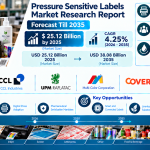


According to Market Research Future® (MRFR), the Pressure Sensitive Labels Market is projected to grow from USD 25.12 billion in 2025 to USD 38.08 billion by 2035, registering a compound annual growth rate (CAGR) of 4.25% during the forecast period from 2026 to 2035. Pressure-sensitive labels are widely used across packaging and product identification because they can be applied without requiring heat, water or a separate activation step. Demand is supported by e-commerce logistics expansion, digital printing adoption and pharmaceutical serialization requirements, alongside opportunities in connected labels and sustainable substrates.
Pressure Sensitive Labels Market Overview
Pressure-sensitive labels combine a face material, adhesive and release liner or another suitable backing arrangement. When pressure is applied, the adhesive bonds the label to a surface, making this format suitable for products that require identification, branding, instructions or traceability. Labels can be designed for a wide range of substrates and operating conditions, with material and adhesive choices influencing durability, appearance and application performance.
The market serves businesses that need labels for consumer goods, healthcare products, household supplies and industrial applications. Label requirements vary considerably: food packaging may prioritize shelf appeal and legibility, while healthcare applications may demand reliable identification and compliance with applicable standards. Industrial labels can require resistance to handling or environmental exposure. This variety supports demand for multiple printing processes, adhesive chemistries and label constructions.
Key Drivers Supporting Market Growth
The expansion of e-commerce logistics is an important market driver. Online retail depends on accurate identification and tracking throughout order fulfilment, warehousing, transportation and delivery. Pressure-sensitive labels can support shipping information, barcodes, inventory identification and handling instructions. As supply chains process a diverse mix of parcels and products, reliable label application and readable printed information remain operational priorities.
Digital press adoption is another significant trend. Digital printing can support shorter production runs, variable information and quicker artwork changes, making it useful for brands managing multiple products, promotional designs or localized packaging. The ability to produce different label versions with less reliance on conventional plate preparation can help converters respond to changing customer requirements. Its suitability depends on production volume, print quality, material compatibility and total job economics.
Pharmaceutical serialization mandates also influence demand. Healthcare supply chains use identification systems to help track products and support verification requirements. Labels may carry batch details, barcodes and other information needed for product handling and traceability. Manufacturers and converters must ensure that labels remain legible and compatible with packaging processes while meeting relevant regulatory and customer specifications.
Market Segmentation by Print Process
The market includes flexography, gravure, inkjet, screen, letterpress and other printing processes. Each method offers different advantages in terms of production speed, image quality, substrate compatibility and run length.
Flexography is used for many label applications because it can support efficient production across suitable materials and job volumes. Gravure is associated with consistent image reproduction in applications where its production characteristics and economics are appropriate. Inkjet printing can accommodate variable data and changing designs, which makes it relevant to customized or information-intensive label work.
Screen printing can provide particular visual effects or ink deposition characteristics for selected applications. Letterpress remains an option for certain label formats and production requirements, while other processes may serve specialized needs. The choice of technology depends on the label design, quantity, required finish, turnaround time and the capabilities of the converter.
End-User Demand Across Industries
Food and beverage businesses use pressure-sensitive labels for branding, product information, ingredients, barcodes and other packaging details. Label designs must fit the package and remain readable through expected distribution and storage conditions. Product launches and changing packaging requirements can also create demand for different label sizes, graphics and finishes.
Healthcare applications place particular emphasis on identification accuracy and information integrity. Pharmaceutical labels may need to accommodate serialization-related information and remain compatible with automated packaging lines. Cosmetics and household products use labels to communicate brand identity, product instructions and required information, often across varied container shapes and surface materials.
Industrial users require labels for identification, inventory, asset management and handling. These applications may call for adhesives and face materials selected for the relevant surface and operating environment. Across all end-user categories, product compatibility and consistent application are essential to reducing labeling errors and maintaining packaging quality.
Adhesive Types and Material Considerations
The adhesive categories include water-based acrylic, hot-melt rubber-based, solvent-based and UV-curable systems. Water-based acrylic adhesives are used in applications where their bonding properties and processing characteristics meet requirements. Hot-melt rubber-based adhesives can provide strong initial tack for suitable substrates and conditions. Solvent-based systems serve applications requiring particular performance characteristics, while UV-curable technologies offer options based on specialized curing and formulation requirements.
Adhesive selection affects how a label performs during application and use. Factors include surface energy, temperature, moisture exposure, removability, desired bond strength and the speed of the labeling line. A suitable combination of adhesive, face material and printing system is necessary to deliver reliable results.
Emerging Trends and Opportunities
Smart and connected labels represent an opportunity to integrate product identification with digital information and tracking functions. Depending on the technology, labels may help connect physical products to digital records, inventory systems or consumer-facing information. Commercial adoption depends on cost, compatibility, data infrastructure and the value provided to brand owners and supply-chain operators.
Linerless and sustainable substrates are also attracting attention as businesses examine packaging waste and material use. Linerless formats can eliminate the separate release liner in suitable applications, although conversion and dispensing systems must support the format. Sustainable substrate choices likewise require evaluation of printability, adhesive performance, recycling compatibility and end-of-life conditions.
Emerging-market capacity build-out offers another avenue for growth as packaging demand and manufacturing activity develop. Suppliers and converters may benefit by expanding suitable production capabilities and serving local requirements with reliable quality and delivery.
Competitive Landscape and Outlook to 2035
Avery Dennison, CCL Industries, UPM Raflatac, Multi-Color Corporation, Coveris and Constantia Flexibles are among the key players identified in the market. Competition includes material innovation, printing capabilities, product consistency, technical support and the ability to meet different customer specifications.
The market is forecast to reach USD 38.08 billion by 2035, compared with USD 25.12 billion in 2025, at a CAGR of 4.25% over 2026–2035. E-commerce logistics, digital production methods and traceability requirements are expected to remain relevant to demand. Companies that combine application-specific solutions with efficient production and sustainable material options may be positioned to address evolving requirements across packaging, healthcare and industrial labeling.