
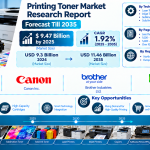


According to Market Research Future® (MRFR), the Printing Toner Market is projected to expand from USD 9.47 billion in 2025 to USD 11.46 billion by 2035, registering a compound annual growth rate (CAGR) of 1.92% during the forecast period from 2025 to 2035. The market was valued at USD 9.3 billion in 2024. Continued demand for dependable document printing, improvements in printing technology and growing interest in efficient consumable management are influencing the industry. Sustainability initiatives, high-capacity cartridges and smart technology integration are also shaping product development and purchasing decisions.
Printing Toner Market Overview
Printing toner is a consumable used in compatible printing equipment to reproduce text, graphics and images on paper and other suitable media. It is widely associated with laser printers and photocopiers, where toner particles are transferred through an imaging process and fixed to the printing surface. Toner formulation and compatibility can influence output clarity, consistency and overall printing performance.
Businesses continue to use printed documents for administrative records, invoices, reports, contracts, educational materials and customer communications. Although digital systems have reduced the need for some paper-based processes, many organizations still require physical copies for operational or regulatory purposes. This ongoing demand supports the use of toner-based equipment across offices, commercial establishments and institutional environments.
The market includes several technology categories, printer types, page-yield ranges and colours. These segments reflect differences in printing methods, equipment requirements and customer workloads. Buyers increasingly consider total operating costs alongside print quality, cartridge availability and equipment compatibility when selecting consumables.
Demand for Reliable and High-Quality Printing
The requirement for clear, consistent printing remains a key market driver. Organizations in education, finance, healthcare, government and professional services use printed materials for a range of everyday activities. Commercial businesses may also require printed presentations, promotional documents and internal communications.
For these users, toner performance is closely connected to the reliability of the printing system. Incompatible or inconsistent consumables can affect output quality and create operational difficulties. Manufacturers therefore need to maintain formulation consistency and provide products suitable for the devices in which they are used.
Cost efficiency is equally important for organizations with regular printing requirements. Procurement teams may compare cartridge prices, expected page yield, replacement frequency and the cost of maintaining printing equipment. High-volume users often look for solutions that balance reliable output with predictable consumable expenditure. These considerations can influence purchasing decisions even in a market experiencing relatively moderate overall growth.
Technology and Printer-Type Segmentation
The market's technology segments include laser toner, inkjet toner, sublimation toner and solid ink toner. Each category serves particular printing systems and applications, making product compatibility a central consideration. Laser toner is used in compatible laser printers and copiers, while the other categories relate to their respective printing technologies and equipment requirements.
Printer-type segmentation covers laser printers, inkjet printers, copiers and multifunction printers (MFPs). Multifunction printers combine several capabilities, commonly including printing, scanning and copying, allowing businesses to consolidate document-related tasks. The consumables required depend on the specific technology and equipment model.
Organizations choosing printing equipment generally consider workload, output quality, speed, maintenance requirements and cost per page. These factors also influence subsequent toner purchases. Suppliers that offer clear compatibility information and dependable product availability can help customers reduce procurement uncertainty and maintain efficient workflows.
Page Yield and Colour Categories
Page yield is another important market segment, with categories covering less than 1,000 pages, 1,000–5,000 pages, 5,000–10,000 pages and over 10,000 pages. Yield ratings help users compare cartridge capacity and estimate replacement frequency. Actual performance can differ according to page coverage, print settings, document complexity and operating conditions.
The colour categories are black, cyan, magenta and yellow. Black toner is essential for monochrome printing and text-heavy documents. Cyan, magenta and yellow support colour reproduction in compatible printing systems. The balance between monochrome and colour demand depends on the user's activities, equipment and output requirements.
A business producing mainly invoices and internal records may prioritize black toner and economical page output. A company printing presentations, graphics or promotional materials may place greater importance on colour consistency. Suppliers must accommodate these different requirements while ensuring that cartridges function correctly with compatible devices.
Sustainability and Product Innovation
Sustainability is becoming a consideration in the purchasing and management of printing consumables. Cartridge recycling, remanufacturing and responsible disposal programmes can help address waste generated by regular replacements. Buyers may assess the availability of collection schemes and the environmental practices associated with the products they purchase.
High-capacity cartridges are another notable trend. Where supported by the printing equipment and workload, these cartridges can produce more pages before replacement, potentially reducing interruptions and simplifying replenishment. Their economic value depends on purchase price, actual yield, print volume and storage requirements.
Smart technology integration can also improve toner management. Print-monitoring systems may track consumable levels, identify replacement needs and help organizations plan supply orders. When combined with inventory management and maintenance processes, these capabilities can support more predictable printing operations.
Competitive Landscape and Opportunities
Key players identified in the market include HP Inc., Canon Inc., Brother Industries Ltd. and Lexmark International Inc. Competition can involve print quality, cartridge performance, equipment compatibility, product availability and cost. Customer support and consumable-management solutions may also influence supplier selection.
Opportunities arise from demand for high-quality printing, the expansion of e-commerce and online services, and the adoption of managed print services. E-commerce businesses may require printed documentation for shipments and fulfilment, while managed print services can help organizations coordinate equipment, maintenance and consumable supplies. The impact on toner demand varies according to printing volumes and the extent of digitalization.
Market Forecast to 2035
The Printing Toner Market is expected to grow from USD 9.47 billion in 2025 to USD 11.46 billion in 2035, at a CAGR of 1.92%. Demand will continue to reflect the needs of organizations that rely on physical documents and compatible printing systems. Suppliers that combine consistent quality, competitive operating costs, dependable availability and responsible product lifecycle practices may be better positioned to serve customers as printing workflows evolve.